
30.10.2026
The Baltic Sea: Balancing trade and security – Ports need more investment
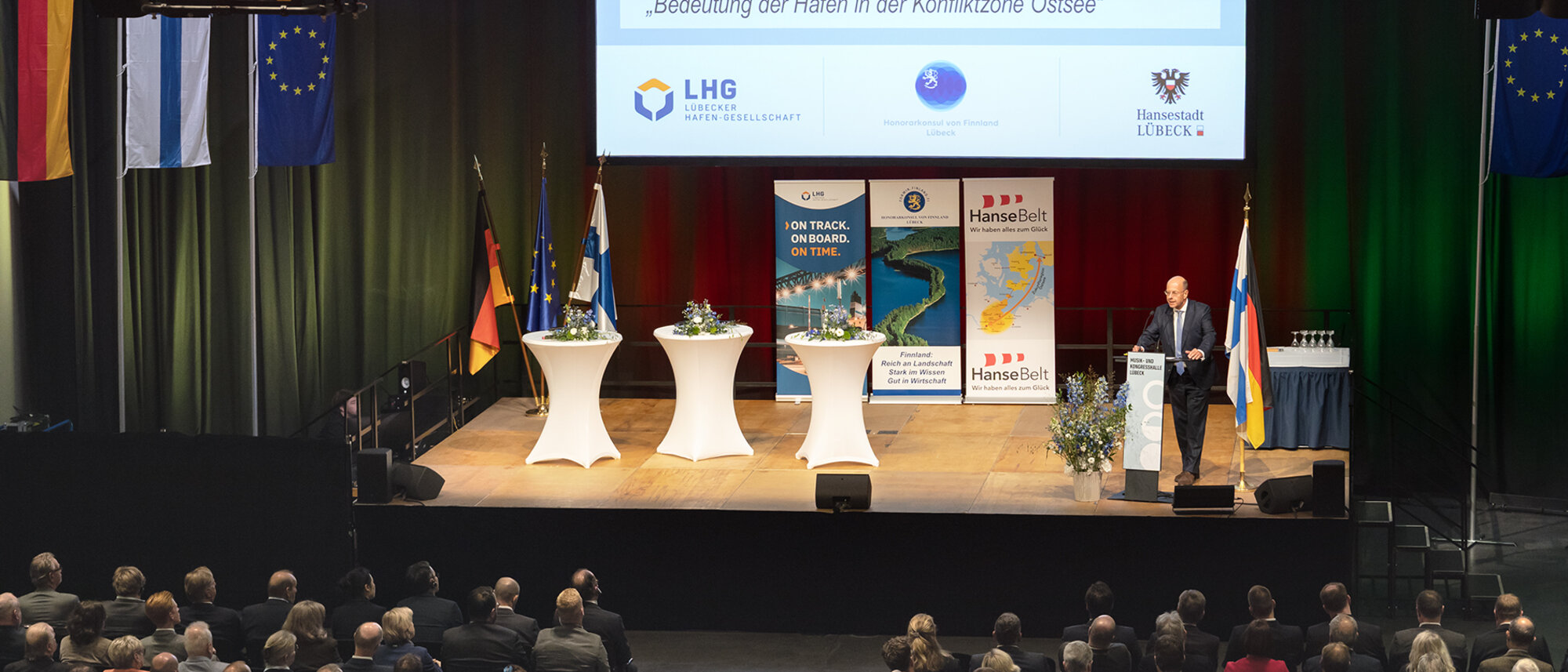
“We must fund today what we will need in an emergency.” With this call, Prof. Dr Sebastian Jürgens argued at the 11th German-Finnish Port Day in Lübeck for greater federal support for seaports. The managing director of the Lübeck Port Authority (LHG) and president of the Central Association of German Seaport Operators (ZDS) highlighted the changing role of the Baltic Sea: It has become a lifeline for trade, particularly for Finland, and at the same time a key region in terms of security policy. In view of new requirements regarding security of supply and military mobility, the ports must be equipped accordingly. Jürgens put the investment backlog in German seaports at around 15 billion euros and called for a permanent federal contribution to their core funding of 500 million euros annually.
Bernd Jorkisch, Honorary Consul of the Republic of Finland in Lübeck, highlighted the economic importance of the Baltic Sea region in his opening remarks: “This economic area is on our doorstep; German trade excluding Russia totalled 340 billion euros in 2025,” he said, referring to the countries bordering the Baltic Sea. By way of comparison, he put the figure for German foreign trade with China at 250 billion euros and that with the USA at 240 billion euros. Jorkisch described the Baltic Sea region as “Europe’s region of the future” and Lübeck as an important logistical hub. At the same time, he urged that ports be regarded as a national priority, given their importance for the economy and security.
More than 400 guests from the worlds of business, politics and diplomacy accepted the invitation from LHG, the Honorary Consulate of the Republic of Finland and the Hanseatic City of Lübeck to attend the event at the Music and Congress Hall on Wednesday.
Security does not end at the quayside
Jürgens is convinced that the new requirements affect not only the ports themselves, but the entire transport chain. A port failure would affect far more than just the terminals: industry, trade and consumers are dependent on functioning supply chains. That is why quayside facilities, transhipment areas, railways and roads must be considered as a whole. Just how real these challenges already are is evident in Lübeck: according to Jürgens, the LHG has carried out exercises there in collaboration with shipping companies to prepare for a cyberattack. These exercises focus on coordinated crisis procedures and clear lines of communication throughout the entire transport chain.
The Finnish port sector, too, increasingly views security and competitiveness as a shared responsibility: Marko Mykkänen, Managing Director of the Port of Oulu and Chairman of the Finnish Port Association, warned of rising logistics costs and emphasised that secure ports are, at the same time, competitive ports.
Rear Admiral Richard Kesten, Chief of Staff at the Naval Command, highlighted the military dimension. During the panel discussion, he described the Baltic Sea as a strategic transport corridor whose vulnerability had increased due to new technical and geopolitical developments. This makes coordinated preparation by authorities, the armed forces and the business sector all the more important.
Finnlines is investing in Travemünde’s future
Finnlines CEO Thomas Doepel emphasised that companies are continuing to develop their transport networks despite the tense security situation: his shipping company plans to deploy three new ‘Hansa Superstar’-class RoPax ferries on the Travemünde–Helsinki route in 2028 and 2029. With 5,100 loading metres each, they offer more than 20 per cent additional cargo capacity compared with the existing ‘Star’ class vessels. These are to be gradually transferred to the Travemünde–Malmö route. Doepel also emphasised how important efficient hinterland connections remain for Travemünde’s role as a transport hub.
Working together for a secure Baltic Sea region
Schleswig-Holstein’s Minister for European Affairs, Cornelia Schmachtenberg, called for closer cooperation amongst the countries bordering the Baltic Sea. No single state can guarantee the protection of critical infrastructure and defence against hybrid attacks on its own. This requires well-established networks and reliable partners.
Lübeck’s Mayor, Jan Lindenau, drew an optimistic conclusion from the Port Day: Despite the new challenges, there is a broad willingness amongst those involved to develop solutions together.
Finland’s Ambassador Kai Sauer summed up just how firmly the German-Finnish Port Day has now established itself as a platform for economic exchange and international cooperation with a tongue-in-cheek comparison: the event is a sort of ‘maritime Davos’ – albeit more down-to-earth and more accessible.
