
02.09.2026
Planned complete closure of the Hamburg–Lübeck route poses major challenges for the port industry
The Lübecker Hafen-Gesellschaft (LHG) has warned of the consequences of the full closure of the Hamburg–Lübeck railway line announced for October. From the company’s perspective, the measure jeopardises the reliable connection of Lübeck’s ports to the German and European rail networks. Numerous customers from industry, trade and logistics will consequently face considerable challenges, whilst established supply chains in the Baltic Sea region will be disrupted.
“We expressly support the modernisation of the rail infrastructure. At the same time, it must be ensured that freight transport can be handled reliably during the construction phase,” says Sebastian Jürgens, Managing Director of the Lübeck Port Authority. “Only by involving all stakeholders at an early stage can viable solutions be developed for the economy and infrastructure.”
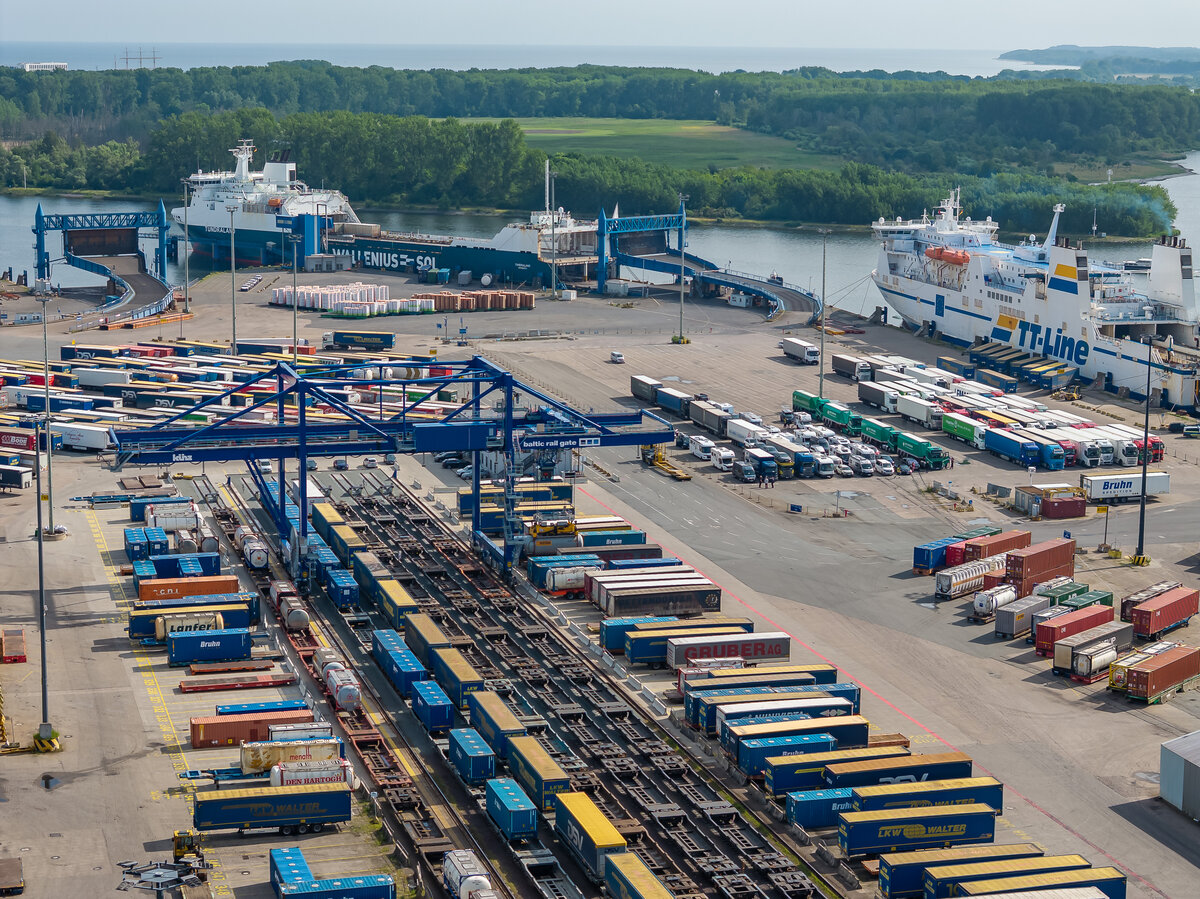
For the ports of Lübeck, rail is a key mode of transport and a major competitive factor. In particular, the Baltic Rail Gate intermodal terminal connects Lübeck with numerous economic regions in Germany and Europe. During the planned 17-day closure, around 260 scheduled train services alone – carrying a total of around 9,400 trailers and containers – will be affected there. Including other block train services, the number of freight trains affected could rise to as many as 340.
According to the port industry, the diversion route via Lübeck, Büchen and Lüneburg proposed by DB InfraGO does not offer the necessary capacity to accommodate the existing freight traffic in full. Among other things, the route is not electrified throughout and can only accommodate longer freight trains to a limited extent. This could lead to significant disruption along the entire logistics chain.
“Our concern is not limited to the immediate economic consequences. The reliability of rail as a mode of transport is also crucial. If customers permanently switch their freight operations to other routes or modes of transport, the damage caused will extend far beyond the actual construction phase,” said Jürgens.
The LHG therefore calls for all possible options to be explored before imposing further full closures, so that necessary construction work can be carried out whilst rail services continue to operate, or with the least possible disruption to rail traffic. Where full closures are unavoidable, well-coordinated and robust diversion plans must be developed at an early stage, and the businesses affected must be bindingly involved in the planning process. From the perspective of the port industry, efficient alternative routes, sufficient freight train paths and coordinated operational procedures must be secured before a full closure begins.
“Full closures must not become the norm. They must remain the exception. We therefore expect that, as a first step, all possibilities will be examined for carrying out construction work whilst rail services continue to operate or with the least possible disruption to rail traffic. If a full closure is technically unavoidable, robust alternative plans for freight transport must be in place,” emphasises Jürgens.
With a view to the infrastructure projects due to take place in the coming years, LHG remains committed to constructive dialogue with DB InfraGO, politicians and the business community. The aim must be to reconcile the modernisation of the rail infrastructure with efficient, reliable and competitive connections to the ports of Lübeck.
Image gallery
![[Translate to English:]](/fileadmin/_processed_/0/9/csm_isabel_venzke-007_klein_9fcd25c066.jpg "[Translate to English:]")