
21.04.2026
Open Baltic Sea, resilient corridors, strong hinterland connections:
At the German-Latvian Port Forum in Lübeck, representatives from ports, business and politics emphasized security in the Baltic Sea as a key prerequisite for stable supply chains, reliable hinterland connections and Europe’s strategic ability to act. The focus was on keeping sea routes open, protecting critical infrastructure and further developing resilient corridors in the Baltic Sea region.
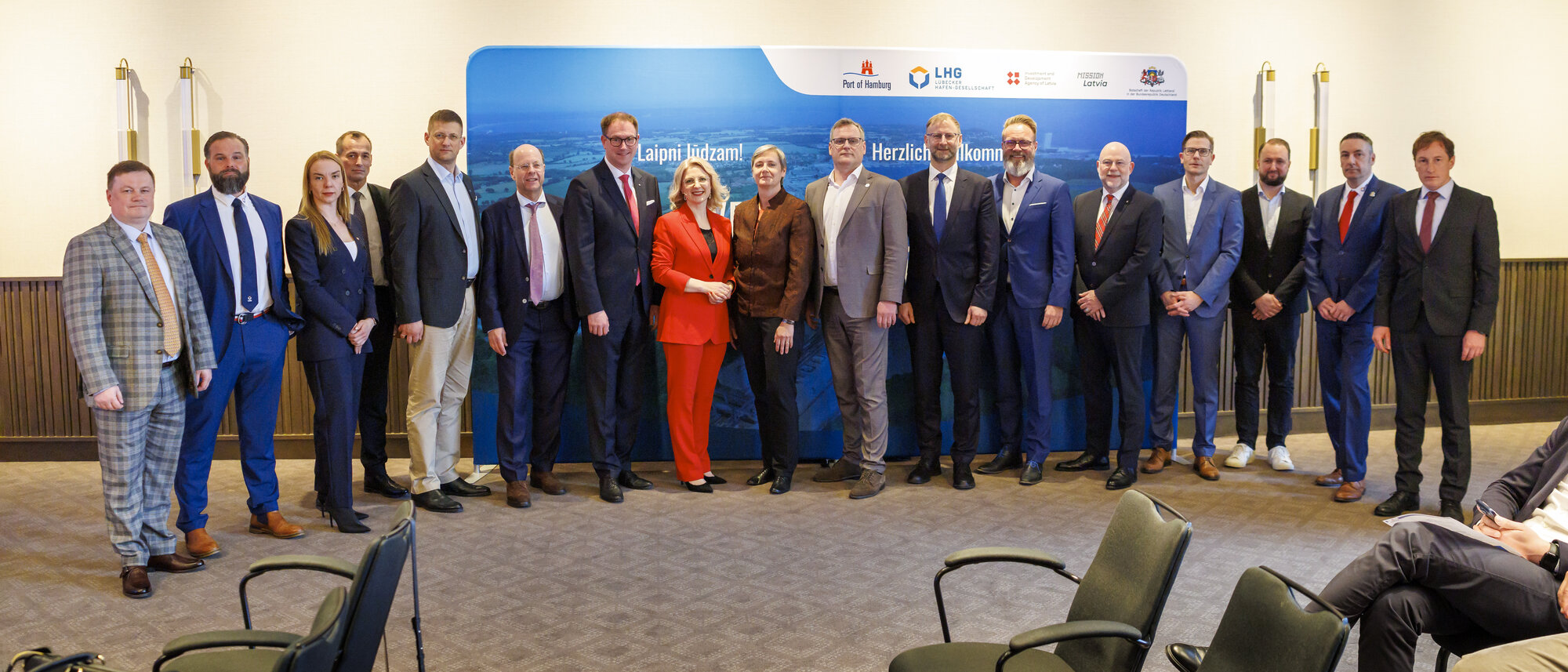
According to the participants, security in the Baltic Sea has become a key issue for ports, supply chains and Europe’s resilience. This assessment shaped the German-Latvian Port Forum in Lübeck, attended by around 100 participants. Representatives from Germany and Latvia made it clear that open sea routes, resilient port structures and dependable hinterland connections are more closely linked today than ever before.
Dr. Andreas Fahrner, Head of Analysis at the German Federal Intelligence Service (BND), described the geopolitical situation in clear terms. “The Baltic Sea and the Baltic ports must remain open,” he demanded. At the same time, Fahrner warned: “How easily maritime routes can be closed can be seen, for example, in the Strait of Hormuz. This must not be repeated in the Baltic Sea.” He also referred to the persistently high number of cyberattacks on critical infrastructure, hybrid threats and the resulting need for geopolitical resilience.
Prof. Dr. Sebastian Jürgens, Managing Director of Lübecker Hafen-Gesellschaft (LHG), added: “The Latvian-German Port Day is particularly important for us because it allows us to further expand our long-standing relationships with our partners. This time, we focused on the joint further development of resilient corridors.” He also emphasized the shared strategic direction: “We are developing our corridors not only for shippers, but also for the defense industry and the energy sector.”
Ansis Zeltiņš, CEO of the Freeport of Riga Authority and Chairman of the European Sea Ports Organisation (ESPO), underlined the importance of close partnerships in the Baltic region: “No matter how large a port is, what matters increasingly is how well connected and how reliable it is in the long term.” Cooperation with other ports and customers is crucial: “Ports should think less in terms of competing with one another and more in terms of jointly securing supply and supply chains.”
Claus Ruhe Madsen, Schleswig-Holstein’s Minister for Economic Affairs, Transport, Labour, Technology and Tourism, and Lübeck’s Mayor Jan Lindenau made it clear that ports today are far more than transshipment hubs: “As part of critical infrastructure, they must remain operational even under pressure. This requires robust rail and road connections as well as close cooperation with shipping lines, customers, terminal operators and authorities,” Lindenau emphasized. The conclusion: resilience does not end at the quay.
Axel Mattern, Executive Board Member of Port of Hamburg Marketing, derived a clear political demand from this: “At the end of the day, resilience is above all a question of money. We must invest in infrastructure and in ports.” In view of the growing demands on hinterland connections and the strategic importance of ports, he called on the federal government to give greater attention and support to the locations and their European environment.
The German-Latvian Port Forum thus sent a clear signal: anyone who wants to strengthen security of supply, reliable supply chains and Europe’s strategic ability to act must keep the Baltic Sea open, make ports more resilient and invest in infrastructure, hinterland connections and cooperation.
![[Translate to English:]](/fileadmin/_processed_/0/9/csm_isabel_venzke-007_klein_9fcd25c066.jpg "[Translate to English:]")