
25.03.2026
There is still a lot of cargo on the road
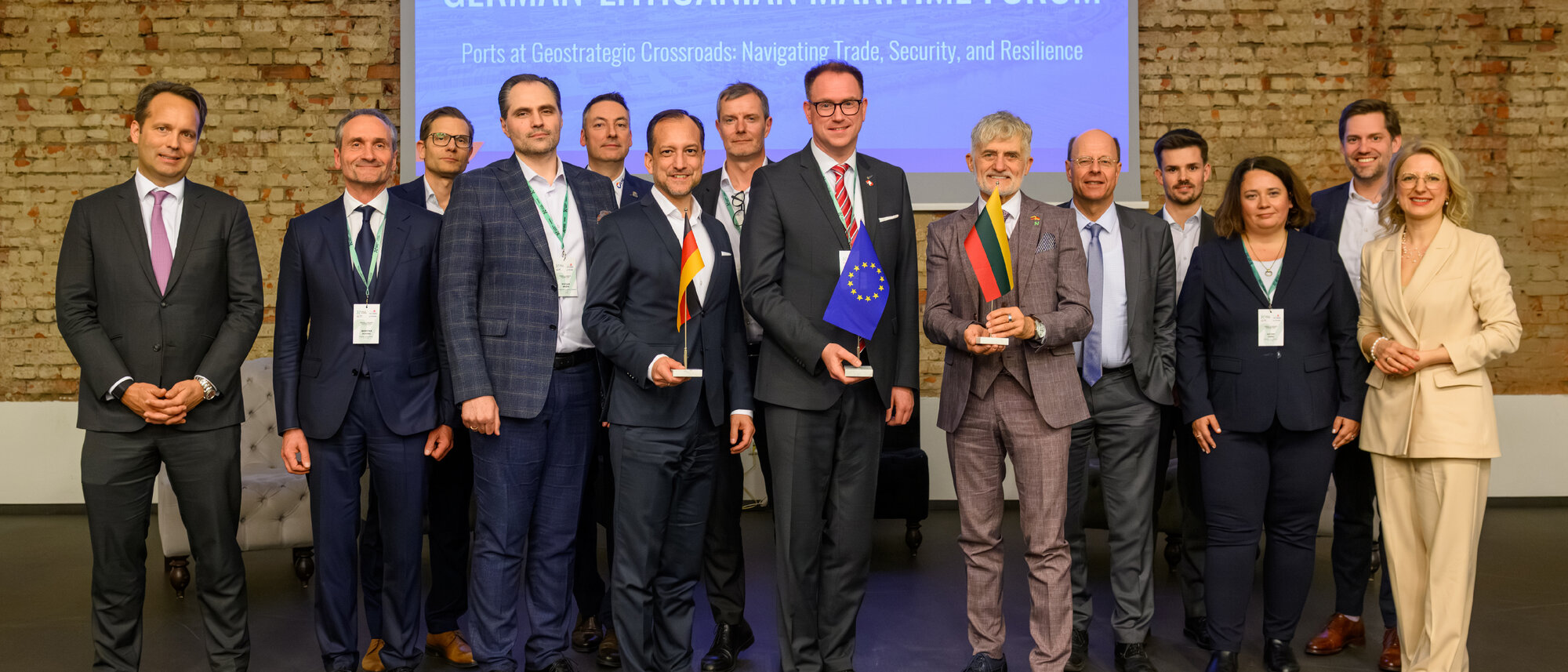
A joint delegation trip by the Lübecker Hafen-Gesellschaft (LHG) and Hafen Hamburg Marketing (HHM) further deepened port cooperation between Klaipėda, Hamburg, and Lübeck. From March 18 to 20, 2026, the program focused on political discussions, company visits, and the German-Lithuanian Maritime Forum.
Around 25 representatives from Lübeck and Hamburg traveled to Lithuania for the event. The forum was attended by over 100 international guests from politics, the port industry, and logistics. The focus was on expanding maritime connections and transport corridors between Hamburg, Lübeck, and Klaipėda, creating more resilient supply chains in the Baltic region, and exploring additional potential for intermodal transport between Lithuania, the Baltics, and Central and Southern Europe. The delegation was led by Lübeck’s Mayor Jan Lindenau and Niels Wiecker, Director of Port and Logistics at the Hamburg Authority for Economy, Labor, and Innovation.
A central highlight of the delegation trip was the German-Lithuanian Maritime Forum, moderated by Marina Basso Michael, Regional Director Europe at HHM. The main theme was: “Ports at the Geostrategic Crossroads: Navigating Trade, Security, and Resilience.”
Sebastian Jürgens, CEO of the Lübeck Port Authority, emphasized at the forum: "There is literally still a lot of cargo on the road. Germany is Lithuania’s number one import partner and number two export partner after Poland. By shifting more of this traffic to ferries and rail, we can make supply chains not only more resilient but also reduce CO₂ emissions by around 70 percent."
Jürgens also highlighted the growing dynamics of Baltic traffic. Currently, there are six ferry departures per week between Lübeck and Klaipėda. With around 60 weekly intermodal connections, Lübeck serves as a central corridor linking Lithuania, the Baltics, and Central and Southern Europe.
"The trip significantly strengthened existing contacts and gave new momentum to the city partnership with Klaipėda," emphasized Mayor Jan Lindenau. "It was particularly important that we were able to schedule a reciprocal visit to Lübeck at the beginning of April. Now the focus is on turning this exchange into concrete projects." He was also impressed by the commitment in Klaipėda to investing in infrastructure, sustainable propulsion, and security measures. Cooperation on port security issues is expected to deepen further.
"Reliable partnerships in the Baltic region are gaining increasing economic and geopolitical significance," stressed Niels Wiecker from the Hamburg Authority for Economy, Labor, and Innovation. "Hamburg brings its international market connectivity, Lübeck its strength as a direct Baltic hub, and both serve as Hinterland hubs. This is the strategic value of this cooperation."
Hendrik Meyn, Board Member of Hafen Hamburg Marketing, highlighted: "Since the 1990s, we have maintained close contacts with Klaipėda and its port, which has also been a member of Hafen Hamburg Marketing for three years. The forum demonstrated how we want to strategically develop these relationships further, benefiting trade as well. With a total of 142,000 TEU handled, direct container traffic between Lithuania and Hamburg increased by 15.4 percent in 2025, making Lithuania Hamburg’s strongest Baltic trading partner."
In 2025, approximately 39 million tons of cargo were handled in the Port of Klaipėda, accounting for around 40 percent of the total cargo throughput of the three Baltic states. Klaipėda continues to strengthen its role as a strategic hub in the region. "We are consistently investing in capacity, resilience, and future projects and explicitly invite German partners to join us on this path," said Algis Latakas, Director General of the Klaipėda State Seaport Authority.
In addition to economic and logistical topics, the resilience of critical infrastructure was a major focus in Klaipėda. According to Latakas, around 56,100 tons of military cargo were handled in 2025, doubling compared to the previous year. "This development underlines Klaipėda’s growing strategic importance in the Baltic region and shows that direct RoRo and ferry connections, such as the link to Lübeck and the direct container traffic to Hamburg, can gain additional relevance in times of crisis," Latakas added.
The delegation trip sent a clear signal for closer port cooperation between Klaipėda, Lübeck, and Hamburg. It strengthened political contacts, enhanced economic exchange along the Baltic corridor, and demonstrated that additional cargo flows from Lithuania to Central Europe can be shifted to existing maritime and intermodal structures – economically sensible, logistically more robust, and with significant CO₂ advantages, as emphasized by LHG CEO Jürgens and HHM Board Member Hendrik Meyn in unison.
![[Translate to English:]](/fileadmin/_processed_/0/9/csm_isabel_venzke-007_klein_9fcd25c066.jpg "[Translate to English:]")